
By Budheswar Mahato, Jagabandhu Sanda- Using Diversity, Rohan Mukerjee –Community Wellbeing
Supporting Forest Communities in Seraikela-Kharsawan District
In the villages of Gamaria, Seraikela, and Chandil blocks of Seraikela-Kharsawan District, Jharkhand, the Keystone Foundation has been supporting community-led forest protection efforts alongside initiatives to claim forest rights under the Forest Rights Act (FRA), 2006. In this regard, members of Van Surkasha Samiti (VSS) / Forest Protection Committees (FPCs) and villagers from 7 villages – Hatnada, Junglikhas, Kalajhor, and Sardabera in Seraikela Block, and Rearda, Barsida, and Lapaibera in Chandil Block. Although the Forest Rights Act (FRA) has been in effect since 2006, its implementation—particularly in Jharkhand—has not been carried out satisfactorily. In this area, CFR titles have been granted to only two villages, Udaypur and Kalajhor, and even these are affected by unresolved issues regarding the extent of the areas granted. With little initiative being taken by the District Administration to facilitate the implementation of the Act and the granting of rights—especially Community Forest Rights (CFR)—the responsibility is now being placed on the villagers and, in particular, the Gram Sabhas, to make use of the provisions under FRA to ensure their forests are safeguarded and protected from potential changes in ownership and diversion for other uses.
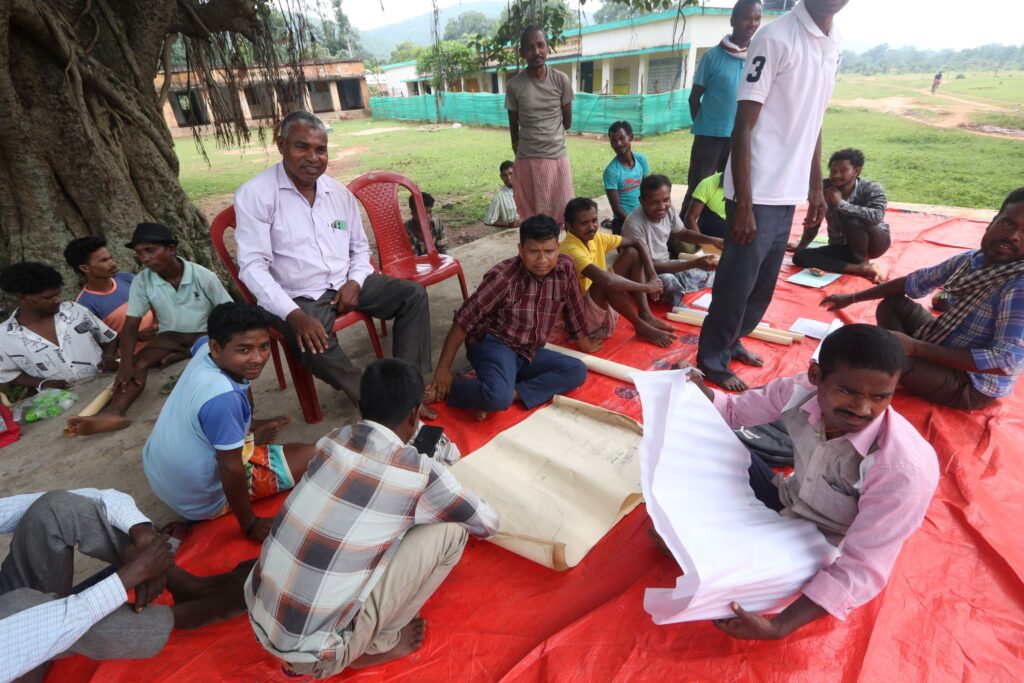
CFR Training in Hatnada Village
The training programme, conducted on 22nd June in Hatnada village, brought together 26 participants, most of whom were members of VSS/FPCs from 6 villages and had been working for the protection and conservation of their forests for several years. The training was chaired by CRP Budheswar Mahato from Hatnada, with resource person Bablu Murmu from Charakpathar village near Sini conducting the training. Bablu has many years of experience in the Development sector, and he fondly remembers his days in SEEDS, where he worked alongside Jagabandhu Sanda. Since then, he has focused considerably on empowering communities to understand and claim their forest rights, having worked closely with Jungle Bachao Andolan across Jharkhand as well as other parts of India.
He recalled having conducted an awareness program on FRA last year here in Hatnada itself, also facilitated by Keystone Foundation, and lamented the limited progress with regards to making claims since then. So Bablu pointed out that today there would be no Bhasan baji/speeches, and instead the focus would be on work and how to ensure that the work gets done. Bablu asked the participants if Forest Rights Committees (FRCs) were in place in their villages, and they shared that while a start has been made to form FRCs in a few villages like Reyarda, they are not sure that the committees meet the requirements as laid out in the FRA. Bablu provided a brief outline of the process for claiming forest rights and CFR in particular covering the role of the Gram Sabha, the formation of the FRC, which is responsible for processing claims at the village level which after which they are submitted to and reviewed by the Sub-Divisional Level Committees (SDLCs) and approved by District Level Committees (DLCs). He also covered the composition of FRCs, emphasising the role of women and how the FRA mandates that at least 1/3 of FRC members should be women.
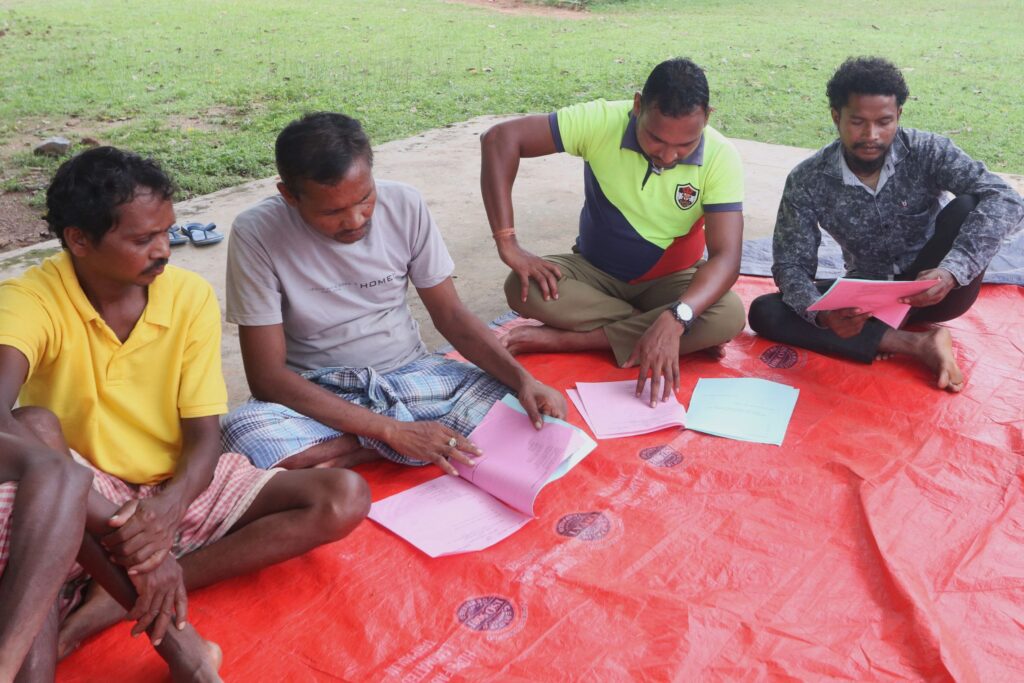
Hands-on Form Training and Discussion on Boundaries
Bablu then shared copies of the CFR claim forms and divided the participants into groups as per the villages they came from, and got them to go through the forms and requirements in detail. Participants took turns to read different sections of the forms aloud, and Bablu explained the different points and requirements, clarifying all doubts of the participants. The importance of fostering understanding among adjoining villages, especially about common boundaries, was discussed in detail. Many participants pointed out the challenges they face due to the lack of clearly defined boundaries on the ground with adjoining villages. While several villagers suggested cutting clear boundaries, Bablu emphasized the value and importance of trees and said that rather than felling trees to mark boundaries, they should use stones and boulders to mark the boundaries. But more than this, there should be mutual understanding and acceptance among members of adjoining villages regarding their common boundaries.
Use of Village Maps and Tracing Techniques
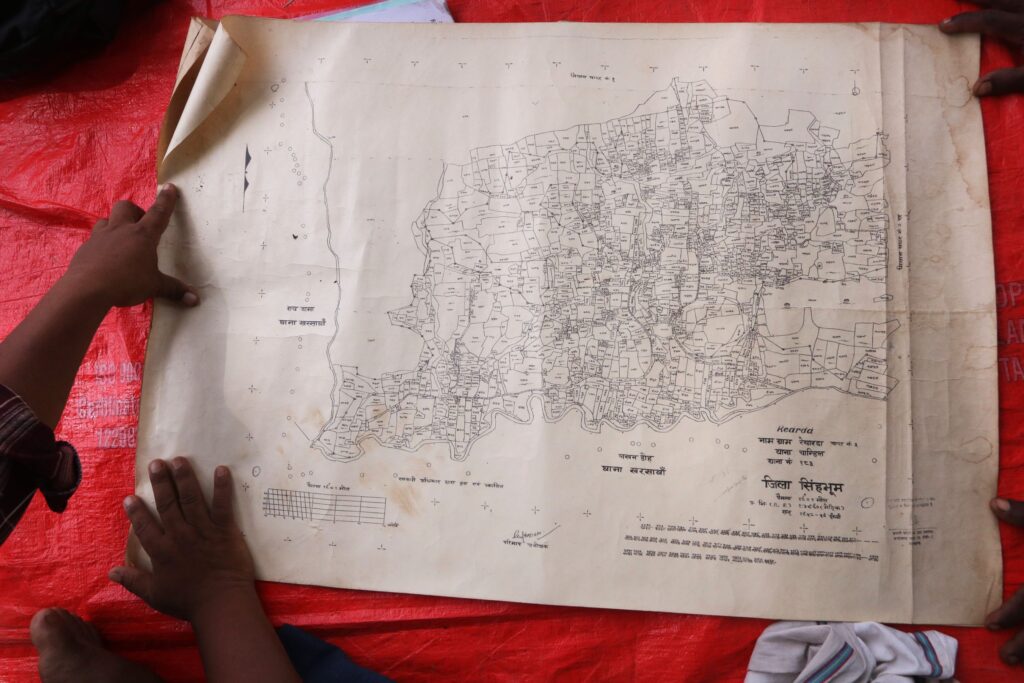
One of the positives of this area with respect to making CFR claims was that the forests have been demarcated, and all the villages have detailed maps that include forest areas. The participants had brought maps of their respective villages, and Bablu went through the maps with them and showed them how to use tracing paper to make copies of their maps for the CFR claims.
Gender Inclusion and FRC Participation
One of the shortcomings of the meeting was the absence of women, and Bablu and the Keystone Foundation team highlighted this and emphasized that women are equal beneficiaries of the forest rights and should be part of the process for claiming CFR titles right from the beginning. The participants shared that they have women members in their VSS and would also ensure adequate women membership of FRCs and strive to foster their adequate participation in the processes for claiming rights.
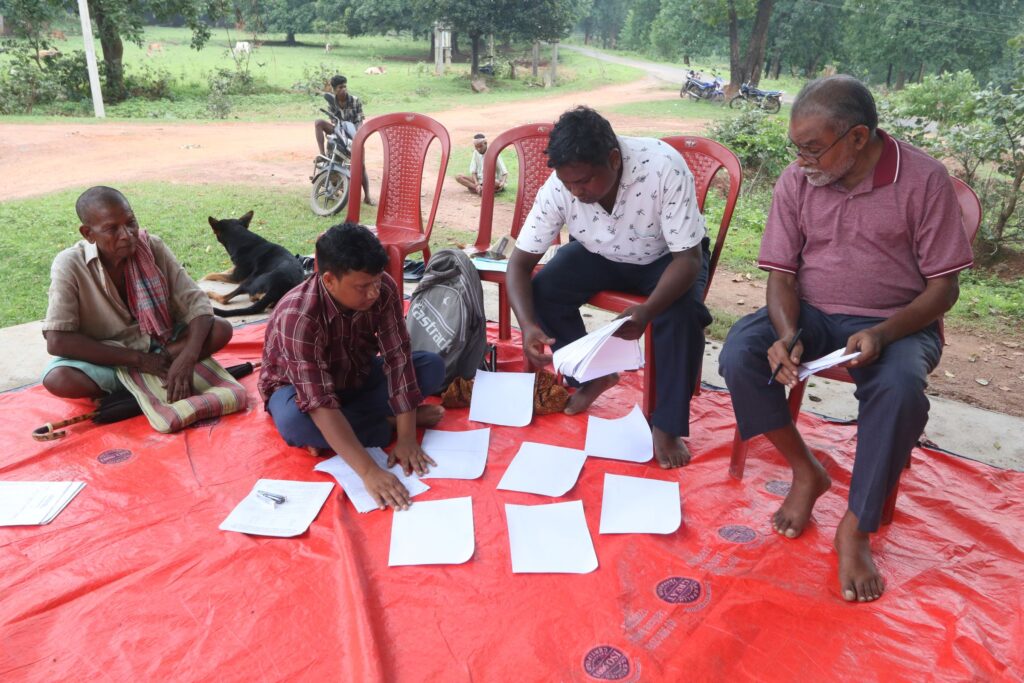
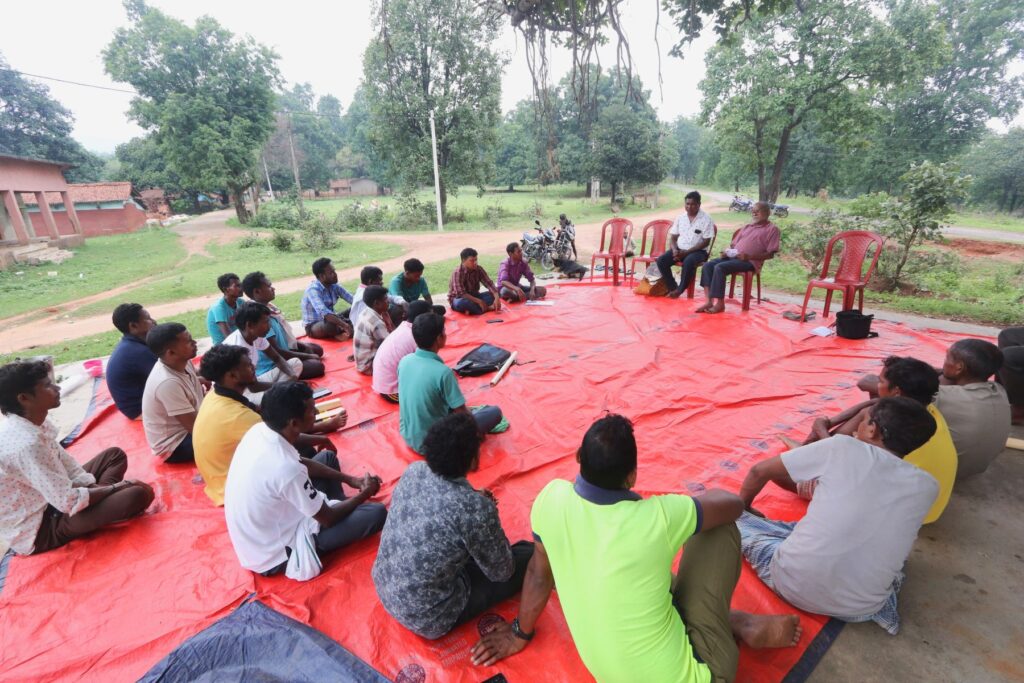
Follow-up Action Plan
In order to ensure that the process of claiming CFR titles is not once again put on the back burner, all participants committed to getting all initial documents and information ready by the following Sunday, after which they will have another joint meeting to assess progress and address challenges.
Discussion on Forest Restoration and Native Species Revival
In addition to covering issues about Forest Rights and CFR claims, the meeting also involved a discussion around the status of forests and the potential for restoration activities. Jagabandhu Sanda (Consultant, Eastern India Initiative) facilitated a discussion on the tree and plant species that have reduced both in forest and habitation areas. Around 19 trees and plants in forest areas and 9 in habitation areas were felt to have reduced considerably. With regards to forest trees, it is worth noting that the reduction in certain tree and plant species was in some cases area-specific, with, for instance, a particular tree having become rare in Chandil block but still being abundant in the forests of Seraikela block. The participants acknowledged the need to promote the revival of trees and plants that have been disappearing from their areas and felt that initiatives like village nurseries and community restoration activities could be good strategies to address these issues, and pledged their support to plan and implement these initiatives in the area. Initially, the establishment of 2 nurseries – one in Sardabera and another in Lapaibera –is being explored, and discussions with respective Gram Sabhas and VSSs are underway.