Rohan Mukerjee, Biodiversity Conservation
As part of Keystone Foundation’s Eastern India initiative, the team organised a hands-on practical beekeeping training in the Kolhan region. In 2025, teams comprising Keystone staff from the Nilgiris and local members and resource persons conducted exploratory visits to identify the potential for beekeeping in the Kolhan region, as well as an introductory training program on beekeeping with staff, consultants, Community Resource Persons (CRPs) and farmers. It was decided to launch pilot bee-keeping initiatives with Apis Cerana Indica in existing project areas in the Kolhan region. However, due to challenges with accessing local bees, it had not been possible to operationalise these plans.
During the March Beej Utsav in the Sundarbans, the Eastern India team met beekeeping expert Manoj Das. Manoj Das promotes beekeeping using the native bee species, Apis Cerana Indica. After the Sundarbans Mela, Bhairab Saini informed us that Manoj could provide bee boxes and training. The training would support people directly involved in piloting beekeeping initiatives in Kolhan. Bhairab Saini is a seed conservator based in Panchal, Bankura district, West Bengal. He has supported the Eastern India team’s agroecology initiatives for several years.
Based on Bhairab’s recommendations, an initial training was planned for the 21st of April in Hatnada village. Upcoming elections in West Bengal prevented road transport of a large number of bee boxes to Jharkhand. However, Manoj managed to bring bees in three nucleus bee boxes. A nucleus bee box is a small specialised hive housing a miniature honey bee colony on 3–5 frames.
It is crucial for starting new hives, raising queens, or splitting colonies, often containing a mated queen, brood, honey, and pollen. Owing to their small and compact size, the Nucleus boxes were easier for Manoj to transport by train. Manoj will transfer the frames to bigger boxes after bringing them from Howrah by vehicle in early May, after the elections.
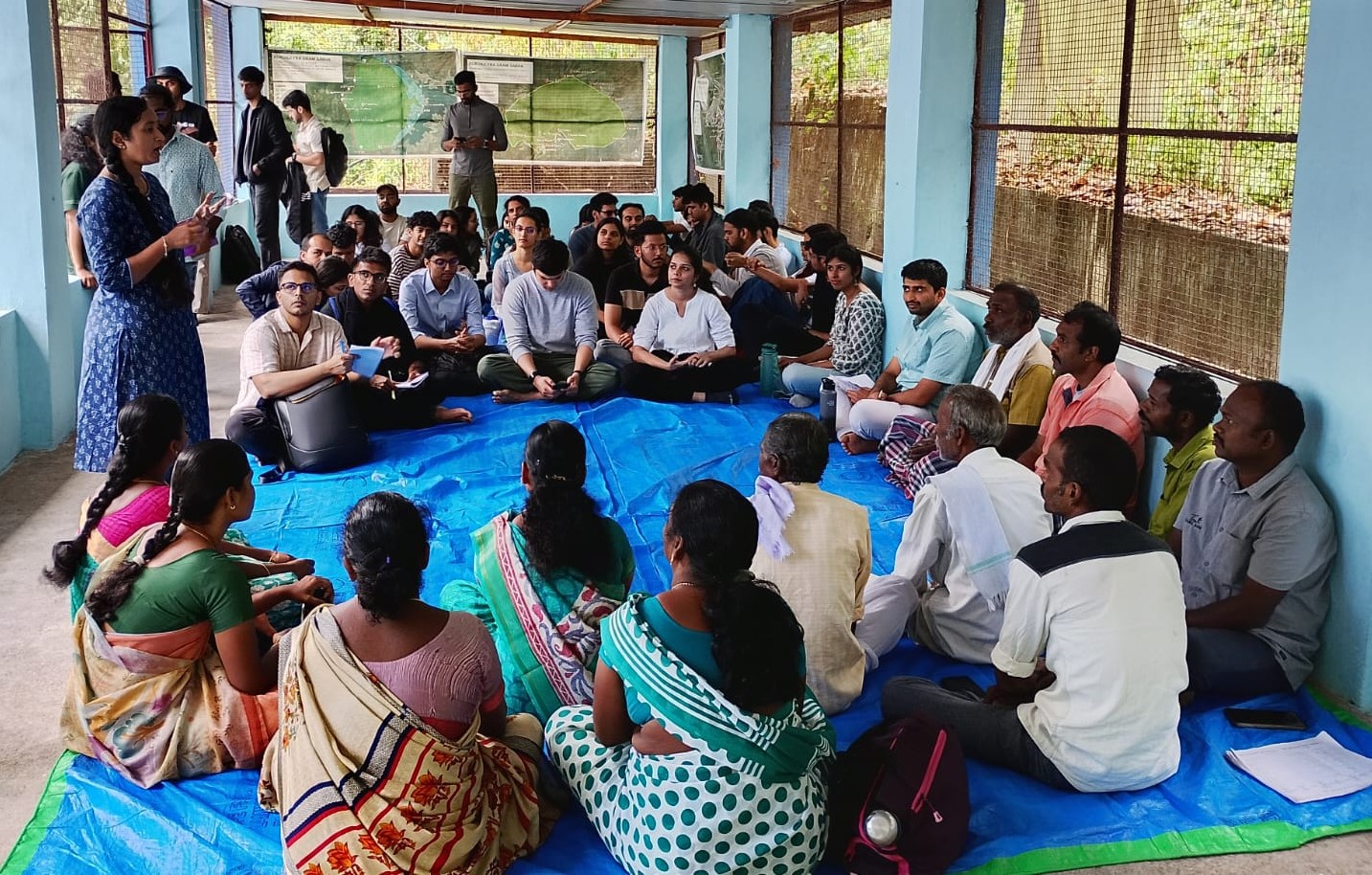
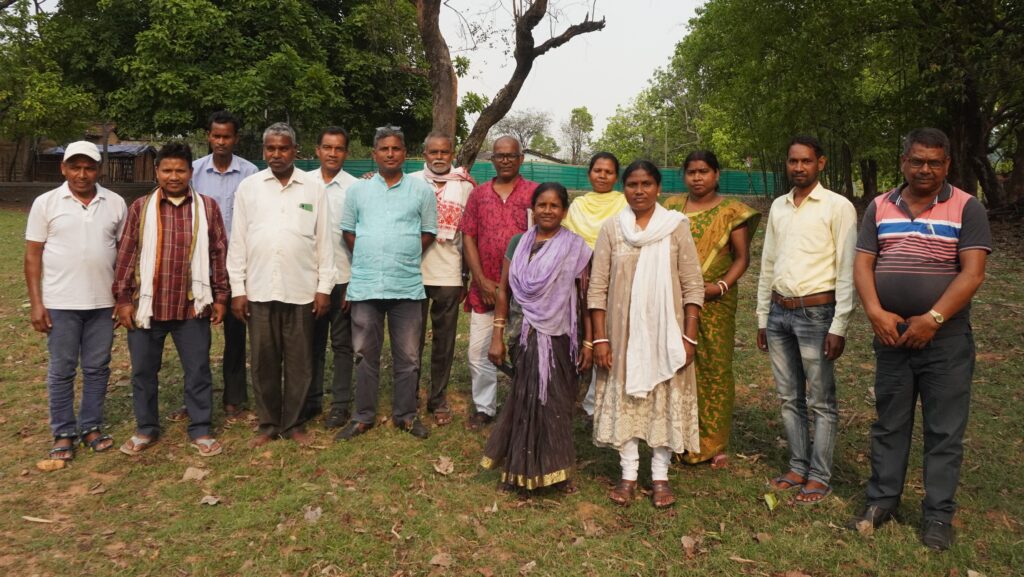
The training was attended by 13 participants in addition to Manoj Das and Bhairab Saini. Manoj and Bhairab had travelled by train to Tata and by a hired vehicle from there to Hatnada.After arriving in Hatnada around 9:30 am, he reported that one comb had dislodged during the journey. He came prepared to carry out the necessary repairs. Manoj demonstrated how to repair a dislodged hive using a knife and dry banana leaf fibre string. He had carried the banana leaf fibre string with him for the repairs.
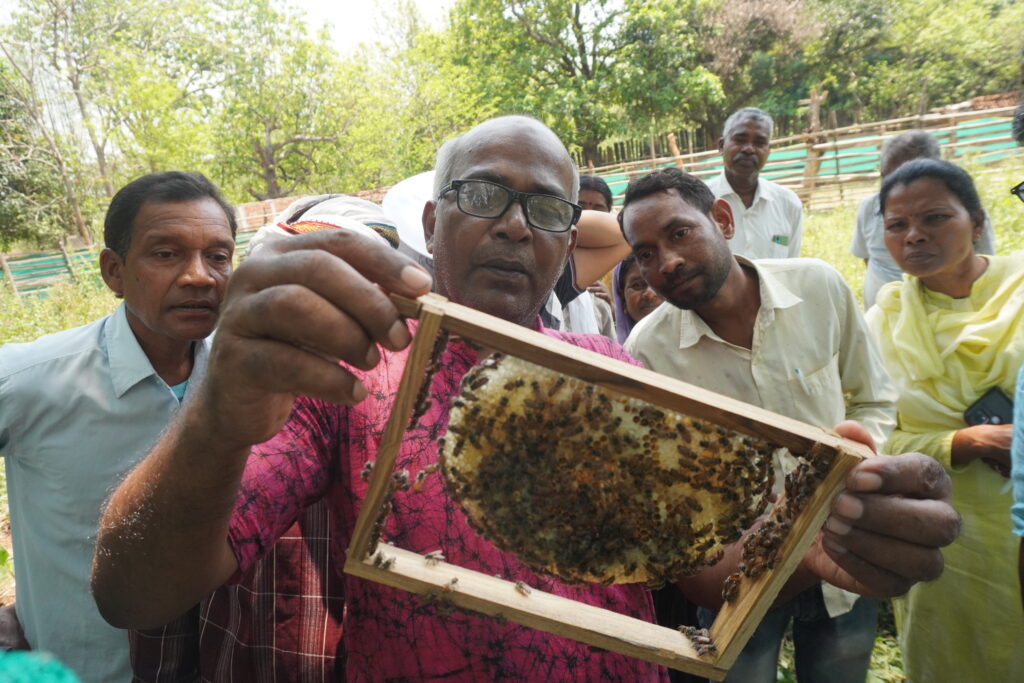
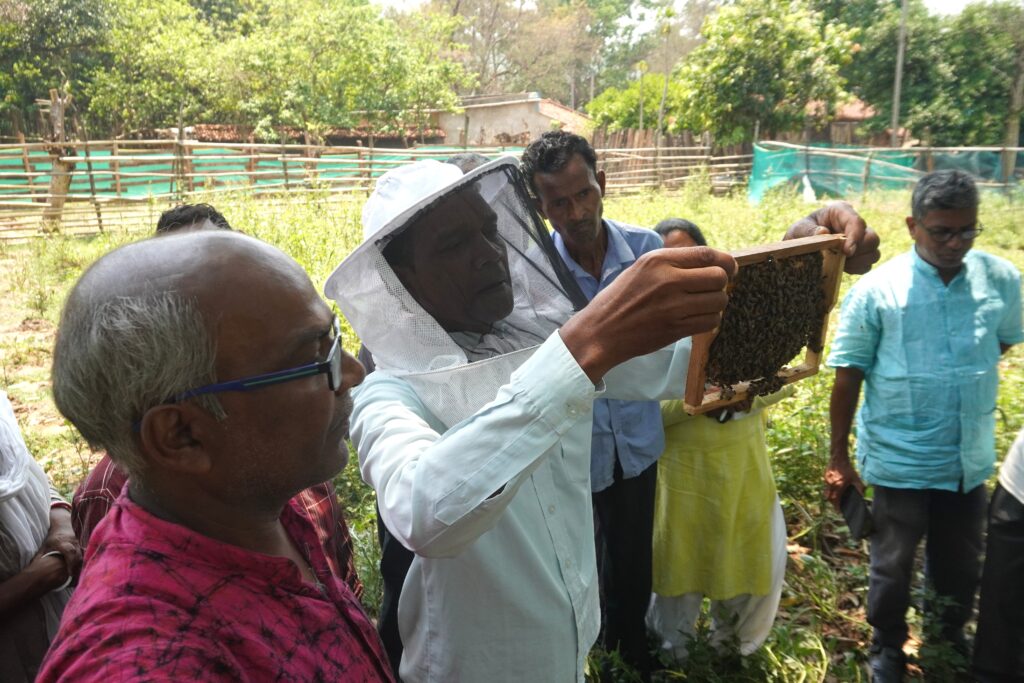
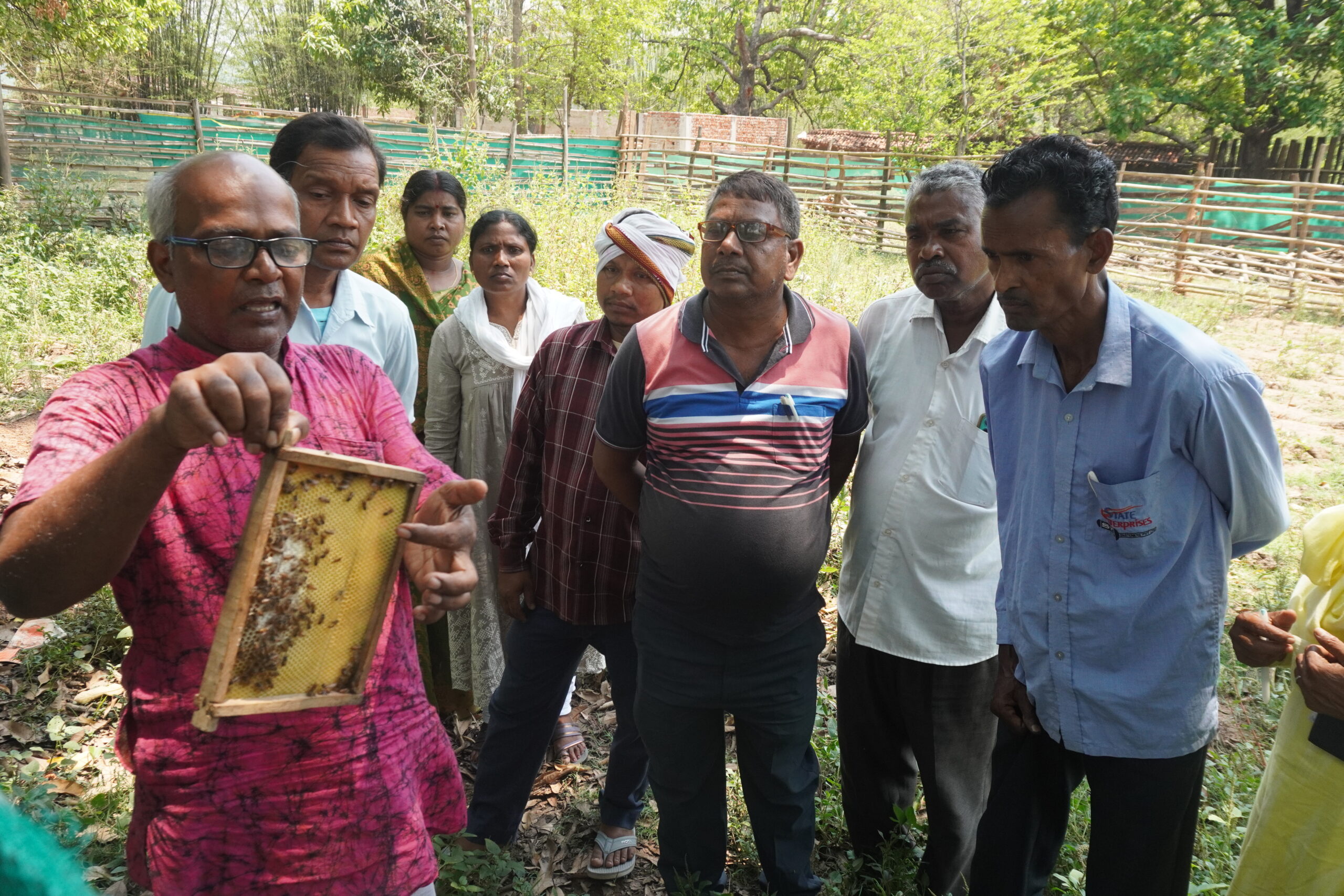
While repairing the comb, I accidentally disturbed a bee and got stung. Manoj was quick to admit that it was his fault and that he had startled the bee. He pointed out that bees will only sting in extreme situations and will die shortly after stinging. Manoj was very calm after being stung, and he removed the stinger with a knife. He also shared that the stinger has a smell which can further irritate and agitate the other bees, so we should apply something on the sting to mask the smell before commencing work with the bee box. Manoj cut a piece of raw mango lying near the hive and rubbed it on the sting to mask the smell.
He shared that people could rub mud on the sting area if nothing else was available. Manoj explained that bee stings usually do not cause serious problems for most people without allergies. He added that the first sting may cause more swelling, but the body gradually adapts over time. As a result, later stings usually cause less swelling. It is usually when people panic that bee stings pose a challenge.
During introductions, Manoj shared that he comes from a farming family practising chemical-intensive modern agriculture. Later, he learned about organic farming and initially remained sceptical about its practices and benefits. Eventually, he adopted organic farming and began social activism focused on environmental and ecological issues. At that time, his elderly mentor encouraged him to create environmental change through action, not just speeches. His mentor explained the ecological importance of native bees and threats caused by increasing chemical farming practices. He also stressed the need to conserve and promote native bee species. For the last 17 years, Manoj has worked to protect and promote bees, especially Apis Cerana Indica.
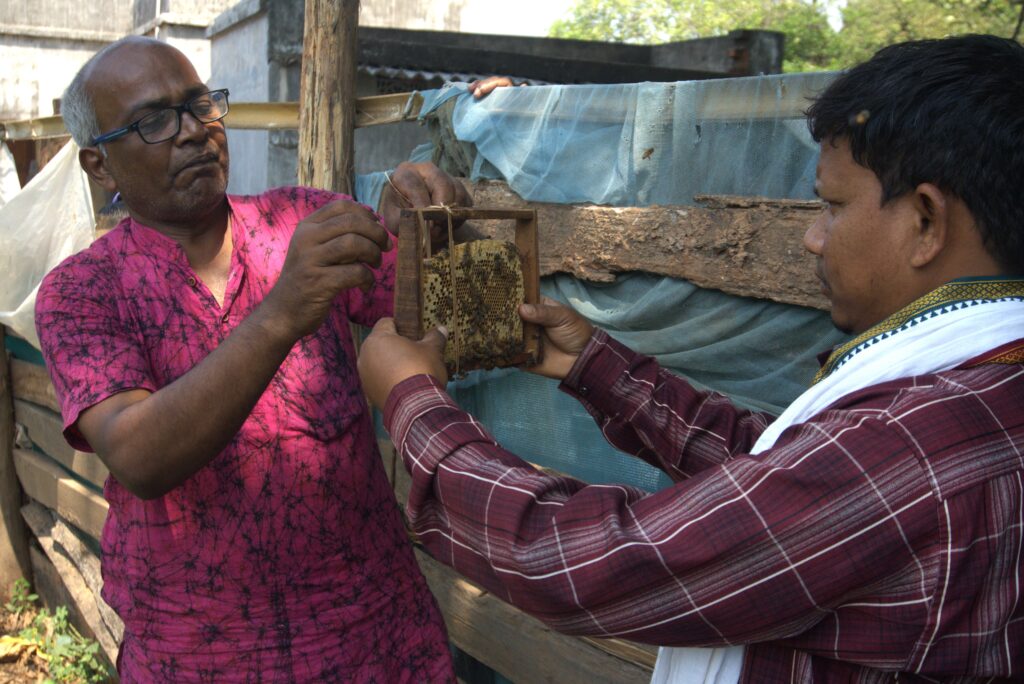
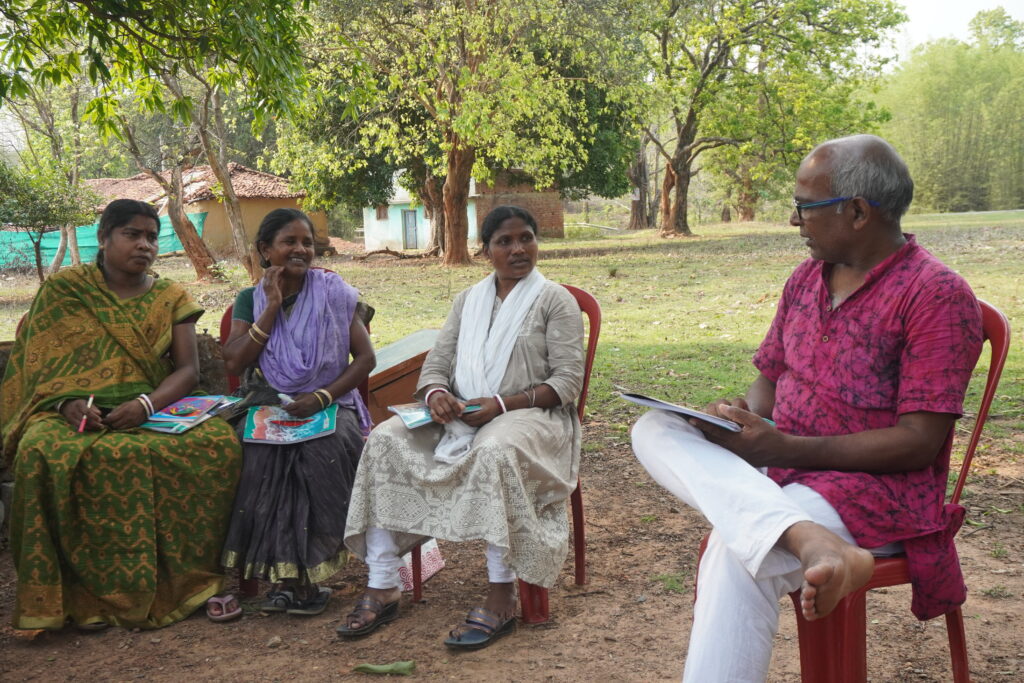
Manoj provided an overview of the ecology and biology of bees, the structure of beehives, hive maintenance, bee behavior, and major pests and threats such as wasps, lizards, moths, and ants.He also shared methods to combat pests and ensure the health of the hive, like providing a sugar solution during lean months.
Manoj shared that bees depend on various cultivated crops, wild trees, and plants for food sources. These include cultivated crops like mustard and maize. After discussions with participants, he felt beekeeping could succeed because wild Apis Cerana Indica colonies exist locally. He identified Apis Dorsata, Apis Florea, Apis Cerana Indica, and Stingless Bees as major Indian bee species. He explained that beekeeping mainly uses Apis Cerana Indica and Stingless Bees. Stingless Bees produce small quantities of medicinal honey.
In India, people also practise beekeeping with the imported Apis mellifera, (Italian bee). Manoj pointed out that bee-keeping with Apis cerana indica is a good option for small-scale organic farmers, as in addition to providing honey, the bees can aid in pollination, helping increase crop yields and productivity. Unlike other livestock, bees require considerably less maintenance. Unlike Apis mellifera, Apis cerana bee boxes do not require regular movement to different locations for pollen and nectar While bee-keeping, one can make consumption of honey a regular habit, which can be very beneficial for one’s health.
He shared that professional sportspeople often consume honey to boost energy levels and recover from fatigue. Honey is also beneficial for common people, and a teaspoon of honey a day can have far-reaching health benefits and even help reduce medicine requirements. The training ended with participants sharing plans for piloting beekeeping in their areas. The team decided to provide bee boxes to two groups in Gurabanda Block. CRP Baby Patar and Kapra Mahali would take responsibility for two bee boxes in Musabani Block, East Singhbhum district.
3 Bee-boxes would be provided in Seraikela-Kharsawan District and one in West Singhbum District under the supervision of CRPs. Manoj would be delivering the bee boxes with bee colonies mostly on the 8th of May. Manoj also shared that he visits Ghatshila regularly, so he could provide necessary support to CRPs and groups in East Singhbhum as and when required. He would provide additional honey-harvesting training after establishing the respective bee boxes.